The Frame Has Edges: What a Camera Leaves Outside
Learn how framing directs attention to visible details and hidden space, so you can read a shot’s edges as part of its meaning rather than its limit.
The most common mistake in reading a film frame is to treat its edges as a border around the whole scene. That can make a viewer miss how framing directs attention, withholds information, and invites the imagination to complete what the camera does not show.
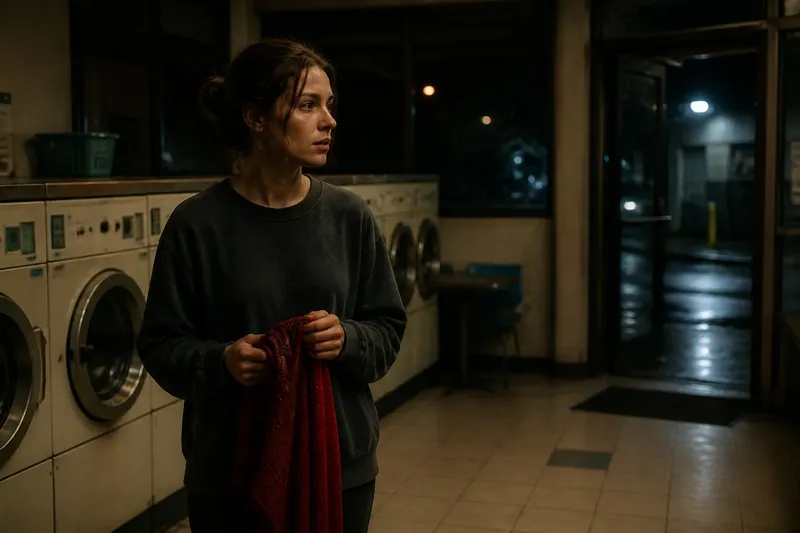
Imagine a clearly hypothetical scene: Mara waits in a laundromat after closing, holding a damp red scarf. The film shows her from the waist up, with a row of empty machines behind her and a glass entrance just beyond the right edge. Nothing outside the image is visible, but the composition gives that unseen space a role.
The visible arrangement
At first, Mara is placed near the center of the shot. The red scarf stands out against the pale machines, while the dark windows behind her offer little detail. The framing makes her face and the object easy to notice, but it also leaves room around her body, keeping the laundromat’s emptiness in view.
That arrangement is not simply a record of what was in front of the camera. A camera operator could include more of the floor, move closer to Mara, or shift the image toward the entrance. Each choice would change what receives attention. Framing means selecting a portion of space and organizing what remains inside it.
For a viewer, a useful first question is: what does the shot make easy to see? Here, the scarf is sharply legible, and Mara’s face can be read. The dark glass is harder to interpret. The difference between a prominent detail and a vague area matters, because the image can guide attention without explaining every part of the scene.
The unseen entrance
In this invented situation, the entrance sits outside the right edge. Mara glances toward it, then looks back at the scarf. The shot does not show what prompted her glance, or whether anything is there. Instead, her eye line gives the viewer a direction to consider.
Offscreen space is the area understood to continue beyond the image. It is not automatically mysterious or important; it becomes meaningful when a glance, a sound, an object, or the scene’s arrangement gives viewers a reason to imagine it. Mara’s look makes the doorway a possible source of attention, while the empty machines make the rest of the room feel exposed.
Notice the distinction between evidence and inference. The image provides evidence that Mara is looking toward the right. A viewer may infer that someone has arrived, that she expects someone, or that she is reacting to a noise. The shot alone does not establish which explanation is correct.
A shifting composition
Suppose the hypothetical scene continues with Mara taking a few steps left, stopping beside a machine, and turning toward the entrance again. The camera stays still. As she moves, the open area at the right edge becomes more noticeable, and the scarf drops partly below the bottom edge.
The frame has not changed, but its balance has. Mara’s movement makes the unoccupied space seem newly charged; the missing view of the entrance now feels more deliberate. Meanwhile, the scarf is less available to the eye. The shot has shifted the viewer’s attention through performance and placement, without needing to reveal anything beyond the image.
This is why the edges deserve attention. The top edge may cut off a face or ceiling detail; the bottom may exclude hands or an object on a table; the sides may conceal a doorway or another person. Ask what the composition crops, then ask whether the omission changes how the visible action can be understood.
Questions about offscreen space?
What counts as offscreen space?
It is the space a scene implies beyond the image’s borders. A character’s gaze, a sound, or a movement that begins at an edge can make that area feel present even when it is unseen.
Does a glance prove someone is there?
No. A glance shows where a character directs attention, but it does not by itself identify the cause. Treat a possible person or event beyond the edge as an interpretation until the film supplies more evidence.
How can I tell whether an edge matters?
Look for a connection between the edge and something inside the shot: a face turned toward it, a hand reaching toward it, or an object partly cropped there. If nothing draws attention to that border, it may simply mark the chosen composition rather than signal a hidden event.
Can a wide shot still make space feel hidden?
Yes. A wide view can show much of a location while still excluding a corridor, a room behind the camera, or the far side of an obstacle. The relevant question is not how much the shot contains, but what remains unavailable from that viewpoint.
The result of restraint
Return to the hypothetical laundromat. A door chime sounds from offscreen, and Mara turns toward the right edge. The viewer now has a new piece of evidence: a sound associated with the entrance, though the image still does not show who—or what—caused it. The unseen space has become more specific without becoming fully known.
When the film later reveals a delivery worker holding a bundle of folded towels, the earlier tension changes. The entrance was not a threat; Mara was waiting for the delivery. The framing’s restraint let viewers consider more than one possibility, while the later view settled the question. That result comes from the sequence of evidence, not from the edge alone.
A second possible ending would keep the entrance unseen. Mara could pick up the scarf, leave through the left side, and let the glass door remain dark. In that version, the viewer would have to decide whether the chime mattered or merely interrupted her wait. An image can leave a question open without withholding a fact the story needs.
Reading the borders
For a close reading, move from what is plainly visible to what the composition suggests:
- Locate the subject. Notice where people and important objects sit within the frame.
- Check the crops. Identify which body parts, objects, or parts of the setting meet an edge.
- Follow eye lines. Ask where a character looks, while keeping the cause uncertain until the film supplies it.
- Watch movement. See whether a character enters, exits, or approaches a border, and what space that action opens or closes.
- Separate observation from inference. State what the image shows before proposing what may lie outside it.
In the imagined laundromat scene, those observations lead to a grounded reading: the composition emphasizes Mara and the scarf, makes the entrance a possible focus through her gaze, and leaves the cause of her attention unresolved until more evidence arrives. This is a practical way to read framing without turning every dark corner into a clue.
The edges of a shot do not merely stop the picture. They help define its point of view. When watching a film, give those borders the same attention as the center: what the camera excludes may shape the scene, but what the image actually supports should remain the limit of your interpretation.