A Cut or a Fade? Two Ways to Cross a Scene Break
A cut or fade shapes how viewers read a scene break. Choose the transition that clarifies a shift in time or attention without overexplaining it.
The most common mistake when choosing a cut or fade is picking the transition because it looks polished. That can disrupt a scene’s rhythm: a cut may make a pause feel immediate, while a fade can suggest that time is passing or attention is withdrawing. Start with what the viewer should feel changing.
Let the change lead
A cut replaces one image with another at a single instant. It can carry the viewer from a character’s face to a different room, or from one moment to the next, without adding a visible interval. That directness suits a new shot that should feel like the next beat of the same flow.
A fade changes the image gradually, usually by darkening it toward black or bringing it up from black. The transition takes time on screen, so viewers can register a pause as well as a change. Use that pause when the break itself matters: the story may be leaving an event behind, entering a new period, or giving the audience room to take a breath.
Cuts preserve momentum
A cut often works best when an action or thought continues across the boundary. A character reaches for a door in one shot; the next begins as the door opens. The viewer supplies the connection, and the scene moves on without an added visual signal that time has passed.
The same principle applies to dialogue. Cutting from a speaker to a listener can shift attention while preserving the conversation’s immediate flow. A cut can create a sharp contrast between images, too, but that contrast should serve the story rather than simply announce the edit.
A cut does not inherently explain how much time has elapsed. Context must do that work. A changed costume, a new location, altered light, or a line of dialogue can orient the viewer; if the gap remains unclear, the surrounding information may need attention.
Fades mark an interval
A fade gives a scene break a shape viewers can perceive. Fading out can suggest that a moment has ended or that the film is letting an image recede. Fading in can introduce a scene as something newly entered, especially after the previous image has cleared from attention.
A fade is not a precise clock. It does not tell viewers exactly how long an interval lasted, and darkness alone does not specify what happened during it. Instead, it signals a broader change: the earlier moment is closing, and the next one need not feel continuous with it.
Fades also redirect attention. If a scene ends on a face and fades away, the image has time to linger before it disappears. A cut transfers attention at once. Choose according to whether the viewer should remain with the outgoing image or move on promptly.
Match attention and sound
Ask what the audience is following at the boundary: an action, an emotion, a location, or a stretch of time. If one action leads naturally into the next shot, a cut can keep that thread intact. If the audience should sense a break in the thread, a fade gives the separation more weight.
Sound can sharpen the distinction. Dialogue, music, or an environmental sound may continue across a cut and connect two images, while a fade may give sound room to diminish with the image. Neither pairing is mandatory: a sudden sound after a fade can feel startling, and a cut without continuing sound can still imply a clean break. Listen to the transition as well as looking at it.
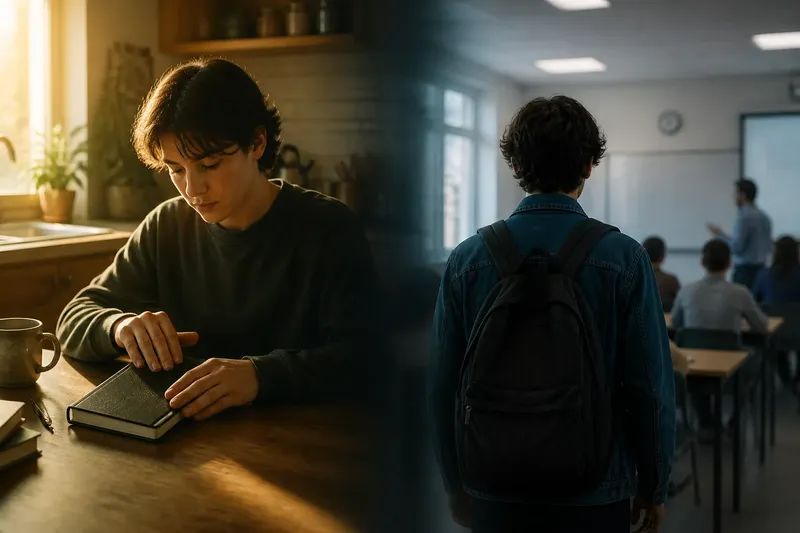
Imagine a student closing a notebook at a kitchen table, followed by a shot of the student stepping into a classroom. A cut can make the move feel like the next beat of a routine. If the intended shift is from one day to another, a fade out and fade in can make that interval more apparent without explaining it in dialogue.
Questions about scene breaks?
Does a cut mean no time has passed?
No. A cut can connect moments that are close together or far apart, but it does not state the interval by itself. Viewers infer time from the images, sound, and story details around the edit.
Does a fade always mean the scene is over?
A fade commonly marks closure or separation, but its meaning depends on placement and context. A fade in can begin a new scene, while a fade out can close one without declaring that the larger story has ended.
Can sound continue across a fade?
Yes. Continuing a sound can bridge the visual transition and connect moments that the fading image separates. Let the sound’s presence or disappearance support the intended shift in attention.
How do I choose between a cut and a fade?
Play the scene with each option and notice whether the break feels too abrupt, too lingering, or appropriately clear. Choose the version that gives the viewer the intended relationship between the two moments, not the one that seems more decorative.
Keep the signal proportionate
A transition should not call more attention to itself than the change it marks. If every scene break fades, viewers may begin to read each one as a broad pause, even when the story is moving through connected beats. If every break is a cut, a major passage of time may need clearer support from the next scene.
Look at the outgoing and incoming images together. A cut between similar motion can feel fluid; a cut between sharply different images can feel forceful. A fade may soften either contrast, but it also lengthens the moment before the next image takes hold. The right choice depends on the scene’s rhythm, not on a universal rule.
For a cut or fade, ask what the viewer should carry across the boundary. A cut carries momentum when the next image belongs to the same immediate flow; a fade makes the interval more noticeable when attention should settle or reset. This is the useful distinction to keep in mind when shaping a scene break.