A Rewatch for Room Tone: Listening Between the Lines
A room tone rewatch helps you hear how ambient sound gives film spaces texture, continuity, and mood without dialogue or musical score.
The most common mistake in a room tone rewatch is listening only for obvious noises: a slammed door, a passing car, a dog barking. That leaves the quieter bed of sound—the air conditioner, distant traffic, a room’s soft reverberation—unnoticed, even though it can make a scene feel inhabited or strangely empty. Set dialogue and musical score aside for a while, and listen for the sound that stays around them.
Set up the rewatch
Room tone is the low-level ambient sound associated with a place. In film, the term can refer both to a recording made in a quiet location and, more broadly, to the audible atmosphere that makes a location seem present. A kitchen may carry a refrigerator hum; an office may have ventilation and distant hallway activity; a forest may hold wind, insects, and birds at different distances.
Choose a scene with a clear location and a stretch of relatively steady action. A conversation in a kitchen or a pause in a station waiting room can work better than a rapid montage, because there is time to notice what persists as the characters speak or move. Use headphones if they are comfortable, or speakers at a level where dialogue remains easy to hear.
On the first pass, watch the scene normally and note where it takes place, who is present, and when the location changes. On the second pass, attend to the background without trying to identify every sound. If your player has subtitles, you can turn them off for this listen; the point is to attend to the soundtrack rather than read dialogue.
Separate the layers
Film sound is often discussed in broad layers: dialogue, music, effects, and ambience. These categories can overlap. A ventilation hum is ambient, while a cup placed on a table is a discrete effect; a distant radio may be music within the scene rather than the film’s score. The distinction is useful as a listening aid, not a rigid rule.
Try a simple mental filter. When a voice stops, ask what remains. When the score pauses, listen again for the same background. Then notice whether the sound seems to belong to the room itself or to an object within it. You do not need to name a source with certainty; “steady low hum” or “muffled activity beyond the door” is a useful observation.
- Continuity: Does the same ambient bed carry through pauses and changes in dialogue?
- Distance: Do some sounds seem near, while others feel beyond a wall or across a street?
- Texture: Is the space dry and close, or does sound linger with a soft echo?
- Change: Does the atmosphere shift when someone opens a door, enters a new room, or steps outside?
When dialogue takes over
A dense conversation can make ambience hard to hear. The usual cause is not necessarily an absence of room sound; voices simply command attention, and the mix may place them prominently. Replaying the same lines at a louder volume often makes the problem worse by drawing attention back to the speech.
Instead, choose a gap: a breath between lines, a pause after a question, or the moment before someone answers. Listen to the fraction of a second around that pause, then replay the same stretch while tracking one background quality, such as a low hum. If the scene offers no quiet gap, listen to its beginning or end, where a voice may not yet have started or may already have stopped.
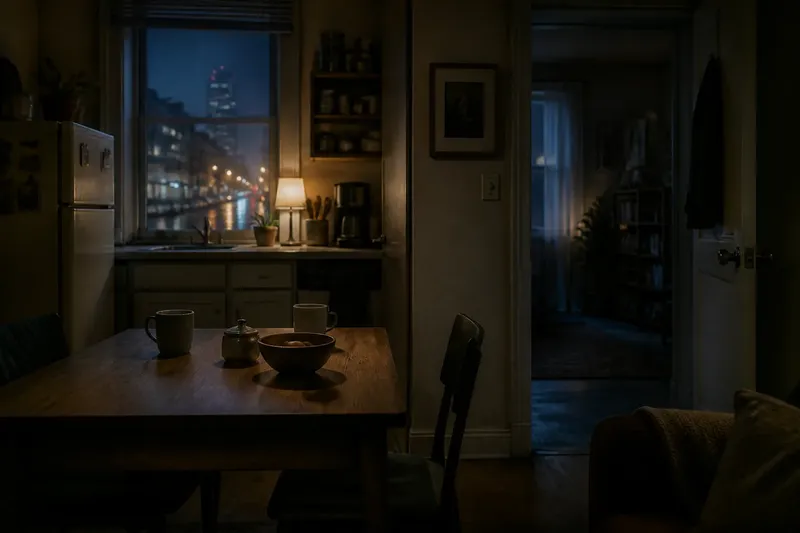
Say you choose an invented scene in a small apartment, where two characters talk over a kitchen table. You first hear only their voices; on a later pass, you attend to the pause after one character leaves and notice a steady appliance hum and faint street noise. The expected observable result is not a new plot point, but a clearer sense that the apartment continues to exist during the silence.
When music masks ambience
A score can cover subtle environmental sound, especially when it sustains a similar tone or fills a quiet passage. The common trap is to treat every continuous sound as music, or to assume that the ambience disappears whenever the score begins. A low musical note and a mechanical drone may occupy similar parts of the listening experience while serving different purposes.
Compare a passage where the score is prominent with a nearby pause or transition. Listen for sounds that appear tied to the location and continue beneath the music: a faint rumble, wind at a window, or reverberation around a voice. Then ask whether the ambient layer changes when the picture moves to another place. If the background remains similar through a location change, it may be part of the score or a deliberate sound bridge rather than a room-specific atmosphere.
Do not worry about assigning every sound to a single source. A film can blend music and environmental sound, or use a designed tone that sits between them. For this exercise, the useful question is what the sound contributes: does it establish a place, hold a mood, connect two moments, or make the setting feel less specific?
When the room feels empty
Some scenes seem strangely bare even though the image shows a furnished room. A likely cause is a mix with little audible ambience, or an intentionally quiet design that makes a pause feel exposed. Another possibility is that the sound is present but very subtle, so a listener focused on dialogue does not register it.
Listen for evidence of the room in the voices themselves. A close, dry voice can suggest a small, soft-furnished space; a longer tail after a word can suggest a more reflective interior. These are clues rather than proof of a particular room, because performance, microphone perspective, and sound design also shape the result.
Next, attend to the edges of the scene. Do you hear a door close with a muted thud, footsteps change as someone crosses the floor, or outside noise diminish when a window shuts? If none of those cues appears, note the absence without treating it as a technical flaw. A quiet space can be an expressive choice, making a character seem isolated or a moment feel suspended.
When a place keeps changing
Ambient sound may shift across shots even when the story remains in one location. A cut can move the apparent listening position closer to a character, or the soundtrack can alter the background to emphasize a new point of view. The result may sound inconsistent if you expect every shot to carry an identical acoustic bed.
Replay the transition and compare what changes: the loudness of the hum, the amount of echo, the distance of a passing vehicle, or the balance between interior and exterior noise. Then check whether the image or action gives a reason for the shift, such as a character turning toward a window or entering a corridor. If the shift has no obvious cause, keep the observation open; it may reflect sound editing, a change in perspective, or a purposeful break in continuity.
For a useful note, describe the effect before guessing at production choices: “the distant traffic drops out at the cut” is more precise than “the sound is wrong.” This keeps attention on what a viewer can hear and leaves room for interpretation.
Questions about room tone?
Is room tone the same as background noise?
Room tone is a kind of background sound associated with a place, but the phrase can also refer to a quiet recording used to help sound editors maintain continuity. In a film rewatch, use it broadly for the low-level atmosphere around action, while distinguishing it from foreground effects when that distinction helps.
Can room tone be heard outdoors?
Yes. The term is not limited to enclosed rooms; an outdoor location can have a bed of wind, insects, distant traffic, or surf. Listen for a stable atmosphere tied to the setting, even if its sources are natural or spread across a wide space.
Why does ambience change between shots?
The sound may follow a new listening perspective, emphasize a character’s attention, or bridge one moment to another. Compare the shots and note the specific change before deciding whether it is a continuity choice or an expressive one.
Should I watch with headphones?
Headphones can make quiet background layers easier to notice, but ordinary speakers can also work if dialogue is clear and the room is not noisy. Choose the setup that lets you listen comfortably without turning the volume up to an uncomfortable level.
Keep a listening note
After the rewatch, write three short observations: one sound that persisted, one sound that changed, and one moment when the background disappeared or became hard to hear. Add the scene’s location and the point in the action, such as “hallway hum continues through the pause” or “street noise fades after the door closes.” Specific notes make a second listen more purposeful than a vague impression that the scene felt quiet.
Return to the scene once more and follow only one observation. If you noted a distant rumble, listen for where it begins and ends; if you noted a change in reverberation, compare the voices before and after the cut. A room tone rewatch is most useful when it leaves you with a sharper ear for the film’s spaces, not a complete inventory of every sound. The next time a scene goes quiet, notice whether the silence has a texture of its own.